
AUTHENTIC MONTESSORI
Primary Program
(Ages 3 – 6 years)
Where children learn not just facts, but how everything connects.
We believe that the more meaningful opportunities we give a child, the closer they can grow toward their fullest potential.
Over the course of the three-year Primary cycle, children build strong foundations in reading, mathematics, geography, science, culture, and social development through purposeful work with authentic Montessori materials.
Village Montessori Primary
A Fully Bilingual Preschool & Kindergarten Program offered at our Coral Way, Shenandoah, and Killian Campuses
When Maria Montessori opened her first school in Rome in 1907, she named it La Casa dei Bambini — the Children’s House. Not simply a classroom, but a living environment thoughtfully prepared for the children who would learn, work, and grow within it. Everything was designed at their scale: within their reach, responsive to their movement, and created to support their growing independence.
More than a century later, this vision remains at the heart of what we have carefully built at Village Montessori.
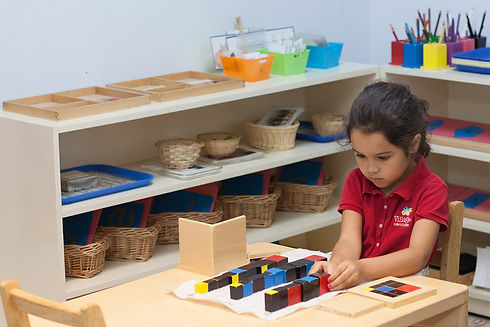
Our Primary Program serves children ages 3–6 years in Miami during one of the most important stages of their development. Within a peaceful, carefully prepared mixed-age environment, children are guided toward independence, concentration, confidence, coordination, and a genuine love of learning through hands-on exploration and purposeful work.
The classroom itself is organized into five interconnected curriculum areas — Practical Life, Sensorial, Language, Mathematics, and Cultural Studies. Rather than isolated subjects, these areas form a unified learning environment where each experience builds naturally upon another, allowing children to move with curiosity and purpose according to their individual development.
A defining characteristic of an authentic Montessori Primary program is the uninterrupted three-hour work cycle, which gives children the time and freedom to become deeply engaged, practice concentration, and develop intrinsic motivation. Guided by highly trained Montessori educators who closely observe and understand each child’s unique path of development, children are empowered to grow academically, socially, emotionally, and independently at their own pace.
The Primary Curriculum
The Montessori Primary Curriculum integrates Practical Life, Sensorial, Language, Mathematics, and Cultural studies into a cohesive learning experience. Younger children learn through observation and repetition, while older children naturally develop leadership, responsibility, and confidence by mentoring their younger peers. This mixed-age dynamic creates a strong sense of community and collaboration rather than competition.
A defining characteristic of a Montessori Primary program is the progression from concrete experience to abstract understanding. Children first learn through movement, touch, and direct interaction with materials before advancing toward more complex concepts in reading, writing, mathematics, science, and geography.
By the kindergarten year, children in an authentic Montessori Primary Program often demonstrate independence, focus, self-motivation, and a genuine love of learning—building a strong foundation for future academic success and lifelong growth.


Hands-On, Concrete Learning
Abstract concepts in math, language, science, and history are introduced through physical materials children can touch, manipulate, and explore — building understanding from the ground up.

Multi-Age Community
Mixed-age classrooms create a living ecosystem of learning. Younger children are inspired; older ones reinforce their own mastery by teaching.
Uninterrupted Work Periods
Our three-hour morning work cycles give children uninterrupted time to develop deep concentration, strengthening the executive functions that support attention, working memory, self-regulation, and flexible thinking.

A Global & Cultural Worldview
Cultural Education in the Montessori Primary environment introduces children to the natural world, human life, geography, science, art, and music through hands-on exploration and storytelling. Children do not learn isolated facts, but begin to form a sense of connection between people, places, and the living world around them.

The child who completes our Village Montessori Primary Program at age six carries something that cannot always be measured on an entry exam but is visible in the way they approach the world: an intrinsic relationship with learning, a strong capacity for concentration, and a sense of themselves as capable and responsible.
For more than eighteen years, we have watched hundreds of children move through the Primary years and grow into confident, capable learners.
This experience continues to strengthen our commitment to the Montessori principles that have guided our work since Village Montessori began.”

OUR COMMITMENT TO PLASTIC FREE ENVIRONMENTS
We are progressively working toward classrooms that are virtually plastic-free.
Maria Montessori was precise about the environment: it must be beautiful, orderly, scaled to the child, and filled with objects that invite purposeful activity. At Village Montessori, we take this principle seriously. Our classrooms are not assembled — they are thoughtfully composed.
For more than eighteen years, we have carefully refined every detail of our environments to support children's independence, concentration, movement, and sensory development.
Every object is chosen intentionally for both its educational value and its aesthetic presence. As part of this commitment, we are progressively working toward classrooms that are virtually plastic-free. This is not a design trend or a marketing statement, but a deeply considered educational, environmental, and health-conscious decision rooted in Montessori philosophy.
Children learn through their hands. The weight of a wooden cylinder, the cool smoothness of a glass pitcher, the texture of a sanded wooden tray — these experiences refine the senses and communicate information in ways synthetic materials cannot replicate. Real materials offer variation in weight, temperature, texture, fragility, and resistance, helping children develop coordination, concentration, care, and cognitive precision through direct sensory experience.
We also believe the environment teaches values silently. By surrounding children with natural materials, beauty, and objects made to last, we nurture respect for the environment and a deeper relationship with the natural world from the earliest years.
Maria Montessori often described the hand as “the instrument of the mind.”
When children interact with authentic materials rich in sensory feedback, learning becomes deeper, more meaningful, and more connected to reality itself. A plastic object and a natural one may appear similar to the adult eye — but to the developing child, they offer profoundly different experiences of the world.